Guide
CPR signs for home pools in Queensland: what the law requires
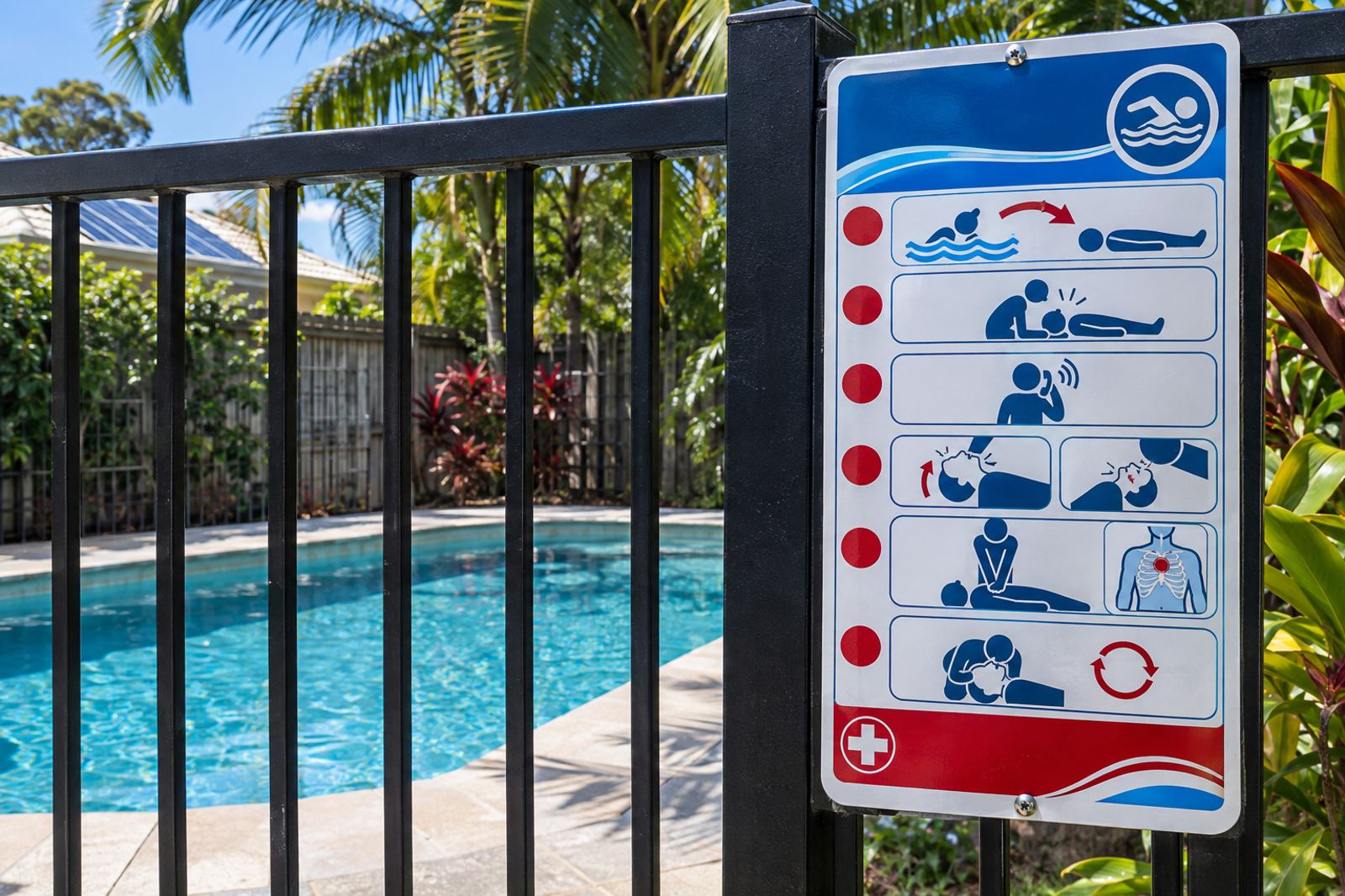
Yes, every home pool in Queensland that is covered by the pool safety laws needs a CPR sign. It must show how to perform CPR, be attached to the pool safety fence or displayed near the pool, be easily visible, measure at least 300mm by 300mm, be durable and weatherproof, and include an emergency statement such as call 000.
Key takeaways
- A regulated pool in Queensland must display a CPR sign that is attached to the pool safety fence or displayed near the pool, easily visible, and at least 300mm by 300mm (QBCC).
- The sign must be durable and weatherproof, carry an emergency statement (call 000, stay with the person, give first aid) and show how to perform CPR.
- The sign should say CPR starts with 30 chest compressions followed by 2 breaths, in line with Australian and New Zealand Resuscitation Council Guideline 8.
- A missing or faded sign can fail a pool safety inspection, and councils can fine owners of non-compliant pools.
- A sign is a back-up only. Fences, self-closing gates and supervision prevent drownings.
Yes, every home pool in Queensland that is covered by the pool safety laws needs a CPR sign. It must show how to perform CPR, be attached to the pool safety fence or displayed near the pool, be easily visible to someone at the pool, measure at least 300mm by 300mm, be made of durable weatherproof material, and include a prominent statement on how to act in an emergency, such as call 000, stay with the injured person and provide first aid. This guide explains each requirement, where to put the sign, what to avoid, and how it fits with the rest of your pool safety obligations.
Which pools need a CPR sign in Queensland?
The CPR sign rule is part of the Queensland pool safety standard, which applies to swimming pools and spas associated with homes, units, hotels and other residential buildings. The state government explains that pool safety laws apply to all pools associated with residential buildings, and that a single standard (MP 3.4, Swimming pool barriers) replaced eleven older standards in 2015.
In practice, that covers in-ground concrete and fibreglass pools, plunge pools, above-ground pools that can hold water over 300mm deep, and spas. If you are weighing up pool types, our guides on fibreglass vs concrete pools and plunge pools explain how each is built. Whichever you choose, the sign requirement is the same.
What does a compliant CPR sign have to include?
The QBCC CPR signs page lists the requirements. Your sign must:
- show how to perform CPR;
- be attached to the pool safety fence, or displayed near the pool;
- be easily visible to a person near the pool;
- be at least 300mm by 300mm;
- be made of durable and weatherproof material;
- include a prominent statement explaining how to act in an emergency, for example call 000, stay with the injured person and provide first aid.
The QBCC also notes that the sign should state CPR starts with 30 chest compressions followed by 2 breaths. The state government publishes a sample sign in its guideline for pool owners and property agents, and that guideline says the sign must be clear, legible and made of durable, weatherproof material.
Some retailers sell signs in slightly different sizes. Always check that the product meets the 300mm by 300mm minimum and the content points above, not just that it is labelled “pool sign”.
What should the CPR instructions actually say?
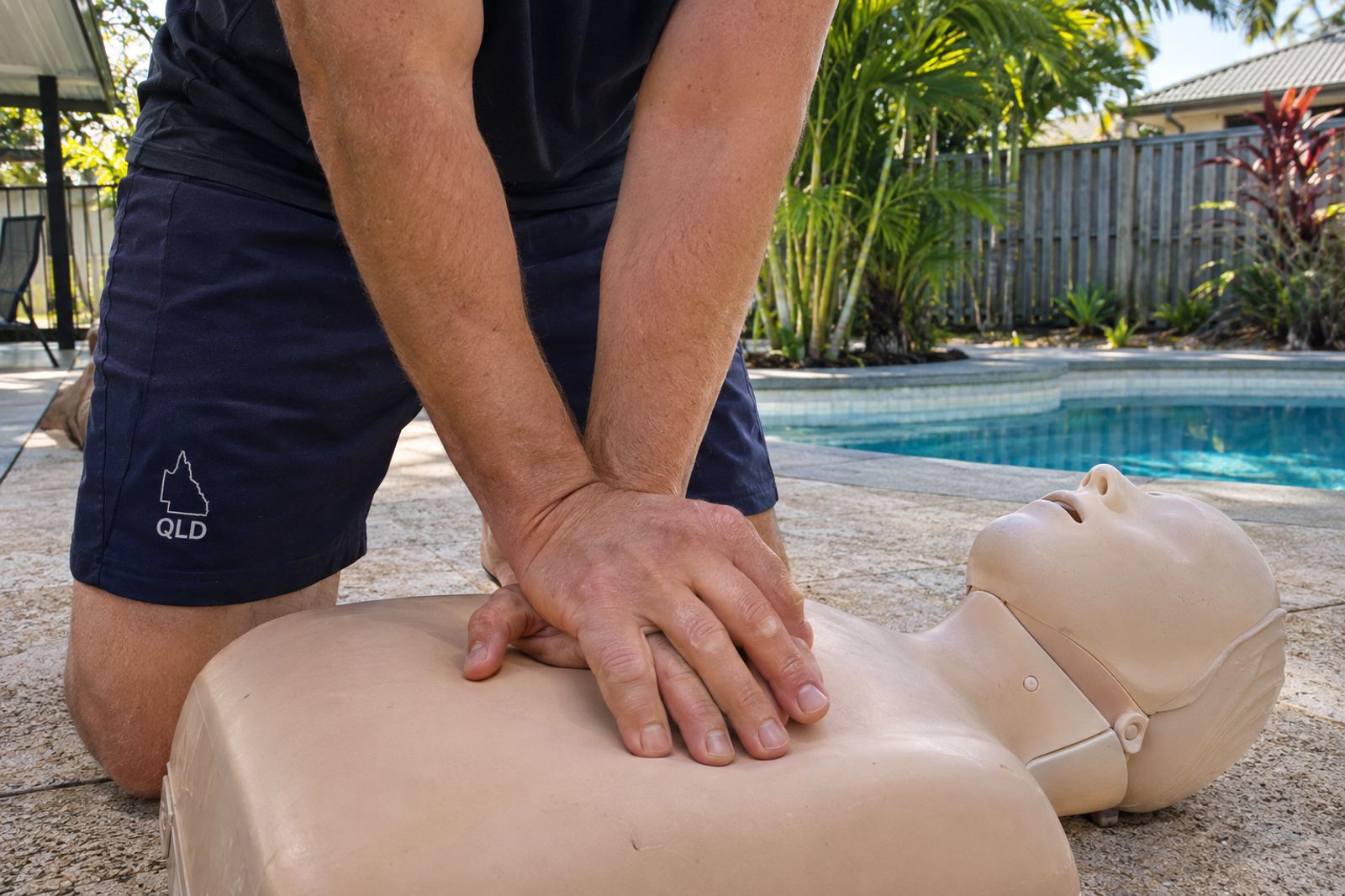
The CPR content should follow the national resuscitation guidelines. The Australian and New Zealand Committee on Resuscitation (ANZCOR) Guideline 8 suggests a compression to ventilation ratio of 30:2 for people in cardiac arrest, and notes that compressions must be paused to allow the breaths. That is why Queensland signs show 30 compressions then 2 breaths.
Royal Life Saving also stresses the importance of breaths in drowning. In a 2025 position statement, it says rescue breaths should be provided during CPR unless conditions make it unsafe, because drowning involves oxygen deprivation. A compliant sign already reflects this.
Where should the CPR sign go?
Attach it to the pool safety fence or display it near the pool where someone standing at the water can see it at a glance. Good positions include:
- on the pool fence panel facing the pool, near the gate;
- on a wall or post beside the pool deck;
- at eye height, not hidden behind plants, furniture or pool equipment.
Avoid fixing anything to the fence in a way that creates a foothold. Under the barrier rules, objects on or near the fence can create climbing points. Our pool safety checklist before summer covers the non-climbable zone and other barrier checks in detail. A flat sign that sits flush on the fence is fine, but never prop a chair or box under it so people can read it more easily.
What happens if your pool has no CPR sign?
A missing, damaged or unreadable sign is one of the simple items an inspector checks. A pool safety certificate cannot be issued for a non-compliant pool until the fault is fixed. Our guide to Queensland pool fencing rules and pool safety certificates explains how certificates work when you sell or lease a property.
Penalties exist for non-compliance. The QBCC says your local council is authorised to check your pool complies and can fine you if it does not, and that unregistered pools can also be fined. The state guideline warns that some monetary fines exceed $25,000, which is a reminder that these are serious laws. Check your own council for current amounts, because on-the-spot fines and court penalties are set by legislation and change over time.
Many councils also offer help. For example, City of Moreton Bay lists the CPR sign requirements on its pools page, including compliance with the resuscitation council guidelines.
How do you keep your sign compliant over time?
Queensland sun is hard on printed signs. Colours fade, plastic cracks and chlorine can lift lettering. Build a quick check into your routine:
- Read the sign from the water’s edge once a season. If you cannot read it quickly, replace it.
- Replace any sign that has peeled, warped or faded.
- Check the guideline date or wording against the QBCC page if your sign is more than a few years old.
- Photograph the sign and fence before any inspection or sale.
Tenants and landlords should know who is responsible. Pool owners and property agents carry the obligations, as set out in the state guideline, so agree on who replaces a worn sign before the lease starts.
Does a CPR sign make a pool safe by itself?
No. A sign helps a bystander act quickly, but it does not stop a child reaching the water. Royal Life Saving’s National Drowning Report 2025 found that drowning deaths peak in summer, with January (23%) and December (20%) the busiest months. Its Keep Watch campaign adds that over the decade to 2025, two-thirds (65%) of them in swimming pools, 183 children aged 0 to 4 lost their lives to drowning. Many incidents involved a gate that had been propped open or not properly closed.
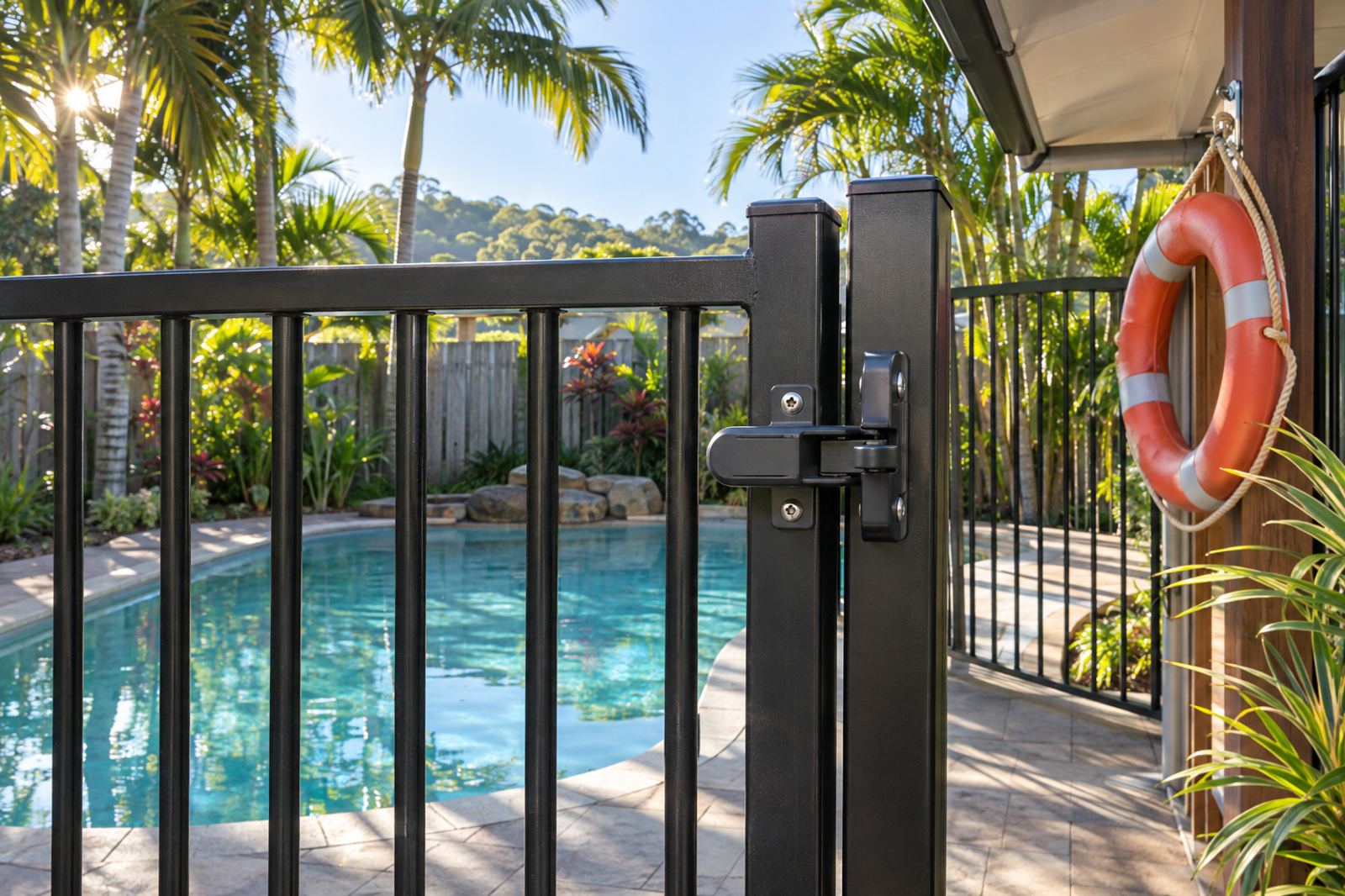
So treat the sign as the last layer. The first layers are a compliant barrier, a self-closing and self-latching gate that is never propped open, a clear non-climbable zone and constant adult supervision. Consider a CPR course for everyone who looks after children near the pool. Royal Life Saving and other accredited providers run short courses, and the resuscitation steps on your sign only help if people have practised them.
How do you choose and install a CPR sign?
Start with the legal minimum, then pick the sign that will last. Look for a rigid, UV-stable material such as aluminium or marine-grade plastic rather than a paper sticker or a thin laminate. Check that the printed instructions are large enough to read in a hurry, with simple diagrams for the compression position and the breaths, and a bold emergency line that tells people to call 000.
When installing, use rust-proof screws, rivets or a strong outdoor adhesive suited to the fence material. Glass, aluminium and tubular steel fences each need different fixings, and drilling a hole in a glass panel is not an option. If you have a glass fence, a wall-mounted or post-mounted sign near the pool is often the tidier choice. Whatever method you use, make sure it does not loosen the panel, block the gate latch or weaken the barrier in any way.
What are the common mistakes with pool signs?
Inspectors and pool owners regularly run into the same few problems, and most are cheap to fix:
- Too small or too faded. A sign under 300mm by 300mm, or one that has been bleached by the sun, does not meet the standard.
- Hidden from view. A sign behind a hedge, a pool pump enclosure or stacked pool furniture is not easily visible.
- Wrong place. A sign inside the house or on a shed across the yard is not near the pool.
- Out-of-date wording. Old signs can use a different compression ratio or an outdated layout. Compare yours to the QBCC requirements and replace it if in doubt.
- Treating the sign as the whole job. A new sign on a fence with a faulty latch still leaves a failed barrier.
When should you check your sign during the year?
The best time is before summer, when pool use and drowning risk both rise. Royal Life Saving data shows that December and January are the peak months for drowning deaths, so a pre-summer tidy-up is well timed. Walk the fence line, test the gate, trim back plants, clear the non-climbable zone and read the sign. It also pays to check again before you list a home for sale or send it to tenants, because a pool safety certificate is part of selling or leasing a property with a pool.
If you are renovating, remember that changes to the fence, gate or pool surrounds can change the compliance picture. A new deck, a raised garden bed or a retaining wall can all alter the non-climbable zone. Talk to your builder or a licensed pool safety inspector before the work starts, and read our guide on how long it takes to build a pool in Queensland if you are planning a full build, so the barrier, sign and inspection are scheduled into the timeline rather than rushed at the end.
Checklist for the pool owner
| Item | What to check |
|---|---|
| Size | At least 300mm by 300mm |
| Content | CPR steps, 30 compressions then 2 breaths, emergency statement (call 000) |
| Material | Durable and weatherproof |
| Position | On the pool fence or near the pool, easily visible |
| Condition | Legible, not faded, cracked or covered |
| Registration | Pool registered on the QBCC pool safety register |
Building a new pool? Ask your builder to include the CPR sign, fencing and gate hardware in the written contract, and confirm they hold the right licence using our guide on how to check a QBCC licence.
Ready to plan a new pool or upgrade your barrier? Use our quote service to compare up to 3 QBCC-checked builders, or browse the Brisbane pool builders hub for local options.
Frequently asked questions
Does a CPR sign need to be a specific size in Queensland?
Yes. The QBCC says it must be at least 300mm by 300mm, easily visible and made of durable weatherproof material.
What must the sign say about CPR?
It must show how to perform CPR and include an emergency statement such as call 000, stay with the injured person and provide first aid. The QBCC says CPR should start with 30 chest compressions followed by 2 breaths.
Where do I put the CPR sign?
Attach it to the pool safety fence or display it near the pool where it is easily visible to a person at the water. Do not create a foothold on the fence.
Do spas and plunge pools need a CPR sign?
Queensland pool safety laws apply to pools and spas associated with residential buildings, so yes, a regulated spa or plunge pool needs a compliant sign.
Can I be fined for not having a CPR sign?
Councils can check pool compliance and fine owners of non-compliant pools. Check your local council for current penalty amounts.
Is a CPR sign enough to make my pool safe?
No. Fencing, self-closing gates, a clear non-climbable zone and constant supervision prevent drownings. The sign only helps in an emergency.
Ready to compare builders?
Get up to 3 free quotes from licence-checked pool builders who work in your area.
Get free quotes