Fibreglass vs concrete pools in Queensland
Fibreglass pools are usually faster to install, often 2 to 4 weeks of site work, and cheaper to maintain. Concrete pools cost more as size grows and take 8 to 12 weeks or longer, but can be built to any shape and suit sloping or tight sites. Your block and design should decide.
Key takeaways
- Fibreglass is usually faster to install (often 2 to 4 weeks of site work), needs less ongoing maintenance and suits flat blocks with crane access.
- Concrete can be built to any shape, size or depth, copes better with slopes and tight access, but typically takes 8 to 12 weeks or more and needs resurfacing every 10 to 15 years.
- Published South East Queensland prices for a standard family pool overlap heavily: both commonly start in the mid $40,000s installed, and concrete climbs faster as size and complexity increase (indicative estimates only).
- The QBCC licenses concrete pool construction and fibreglass pool installation as separate licence classes, so check your builder holds the right one.
- The best choice depends on your site, your design and your budget over 20 years, not just the build price.
In Queensland, fibreglass pools are generally quicker to install and cheaper to maintain, while concrete pools offer unlimited design freedom and handle difficult sites better. Upfront prices for a standard family pool are closer than many people expect, so the decision usually comes down to your block, your design and how long you plan to stay.
This guide compares the two on cost, build time, durability, maintenance, design and suitability for South East Queensland conditions. Cost figures are indicative estimates drawn from builder price lists and guides published in 2025 and 2026.
What is the difference between fibreglass and concrete pools?
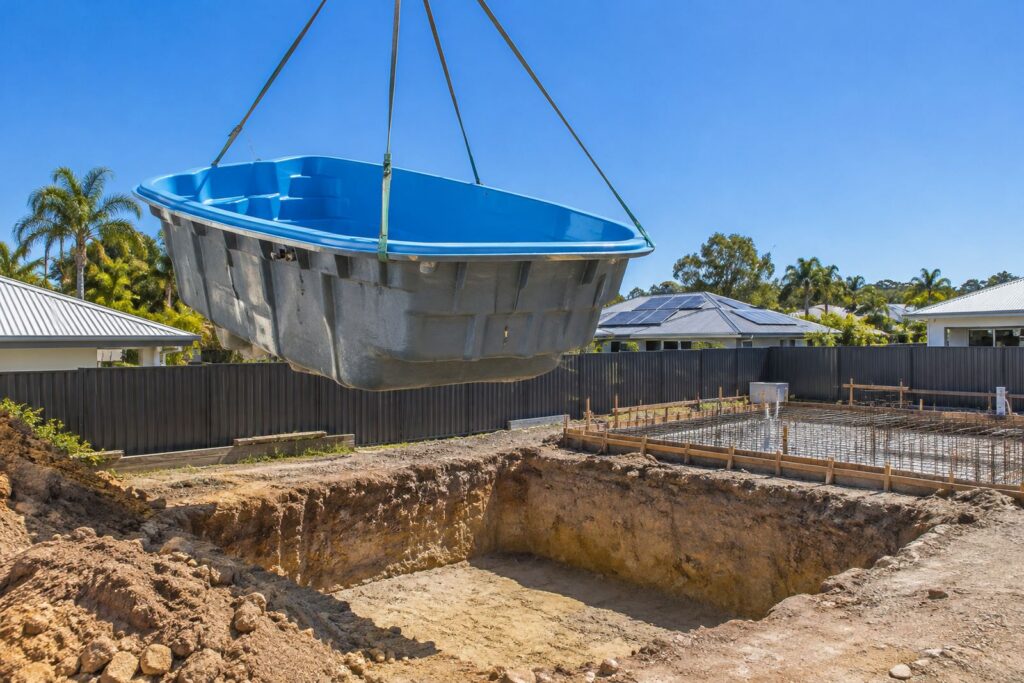
A fibreglass pool is a one-piece shell made in a factory from layers of fibreglass and resin, finished with a smooth gelcoat. It is trucked to your home, lifted into a prepared hole by crane, levelled, plumbed and backfilled.
A concrete pool is built on site. The builder excavates the hole, places steel reinforcement and plumbing, then sprays concrete (shotcrete or gunite) to form the shell. After curing, an interior finish is applied, most commonly pebble in Queensland, with tile as a premium option.
How do fibreglass and concrete pools compare?
| Factor | Fibreglass | Concrete |
|---|---|---|
| Indicative installed price, standard family pool (estimate) | About $45,000 to $85,000 | About $50,000 to $110,000+ |
| Typical on-site build time after approval | 2 to 4 weeks for the pool; 4 to 6 weeks with paving and fencing | 8 to 12 weeks, longer for complex designs |
| Shape and size | Chosen from a manufacturer’s range, usually up to about 11m to 12m long | Any shape, length or depth |
| Surface | Smooth, non-porous gelcoat | Pebble, tile or render; more textured |
| Resurfacing | Not normally needed on the same cycle | Typically every 10 to 15 years; builder guides put it at about $10,000 to $20,000 |
| Chemical use | Generally lower | Generally higher; pH affected by new interiors |
| Difficult or tight access | Needs crane access | Can be built through narrow access |
| Sloping sites | Possible with retaining | Well suited, including suspended designs |
| QBCC licence class | Swimming pool construction, installation and maintenance (installation) | Swimming pool construction, installation and maintenance (construction) |
Which is cheaper, fibreglass or concrete?
For a standard rectangular family pool on a flat block, fibreglass is usually cheaper or about the same price as a basic concrete pool. Fibreglass installers in South East Queensland commonly publish prices from about $45,000 installed for small pools, $55,000 for medium pools and $60,000 to $65,000 or more for large pools. Concrete builders publish base prices from about $45,000 to $55,000 for a modest pool, but most finished concrete projects land between $70,000 and $120,000 once size, tile and surrounds are added.
The gap widens as the pool gets bigger or more complex. Concrete costs scale with every extra metre of length, depth or feature, while a fibreglass shell is a fixed price product.
Site costs can reverse the picture. If a fibreglass shell needs a large crane to lift it over a house, or if groundwater means extra anchoring, the fibreglass quote can rise sharply. On a steep block, concrete may be the only practical choice.
For regional price guides, see pool costs on the Gold Coast, pool costs in Brisbane and pool costs on the Sunshine Coast.
Which lasts longer?
Both can last for decades when properly installed and maintained. Builder guides commonly describe concrete shells as having a structural life of 50 years or more, with periodic resurfacing. Fibreglass manufacturers typically offer long structural warranties on their shells, and some advertise lifetime structural warranties, with separate, shorter warranties on the gelcoat surface.
Read warranty terms carefully. Structural, surface and equipment warranties are usually separate, have different durations and may carry conditions about water chemistry and installation. Also remember that the Queensland Home Warranty Scheme covers structural defects in the building work for 6 years and 6 months, as the QBCC explains, regardless of which pool type you choose.
Which is easier to maintain in Queensland’s climate?
Fibreglass generally wins on maintenance. The gelcoat is smooth and non-porous, so algae has less to grip onto, and many owners find they use fewer chemicals. It is also gentle on feet and swimwear.
Concrete pool interiors are more porous. They can be more prone to algae in humid South East Queensland summers, and pebble interiors may need acid washing over time. A freshly rendered concrete interior also pushes up pH for the first months, so it needs closer attention while it settles.
In both cases, running costs are dominated by the pump, heating and chemicals. A high star rated variable speed pump, a pool cover and a correctly sized heater do more for your bills than the shell material.
Which offers more design flexibility?
Concrete, without question. If you want an infinity edge, a beach entry, a wet edge, a long lap pool, a built-in spa or a pool that wraps around a building, concrete can do it. It can also be designed to fit odd shaped blocks precisely.
Fibreglass ranges have grown, and most manufacturers now offer plunge pools, family pools, lap pools and spa combinations, often with built-in benches and ledges. But you are choosing from a catalogue, and transport limits mean shells are usually no wider than about 4.5m to 5m.
How do South East Queensland soils and sites affect the choice?
- Reactive clay, common across Brisbane, Logan and Ipswich, moves with moisture. Both pool types can be engineered for it, but your certifier may require a soil test and specific footing or bedding details.
- Sand and high water tables, common in coastal Gold Coast and Sunshine Coast suburbs, need careful dewatering during construction. Fibreglass shells can be pushed upward by groundwater if emptied, so builders may add hydrostatic valves or anchoring.
- Rock is common in the hinterland and some hilly suburbs. It increases excavation costs for both types, though concrete can sometimes be shaped to reduce how much rock must be removed.
- Slopes favour concrete, which can be partly elevated or suspended. Fibreglass on a slope usually needs substantial retaining.
- Access matters most for fibreglass, which needs a clear lifting path for a crane.
How long does each take to build?
Once approvals are granted, fibreglass shells are typically installed within 1 to 2 weeks, with full handover including paving and fencing often 4 to 6 weeks. Concrete pools take longer because each stage must finish before the next: excavation, steel and plumbing, spraying, curing (concrete can take up to 28 days to reach full strength), coping, interior and fencing. Builders generally quote 8 to 12 weeks for concrete, and complex builds can take longer. Wet weather affects concrete more because more of the work happens on site.
Our guide on how long it takes to build a pool in Queensland walks through both timelines stage by stage.
What about plunge pools and small spaces?
For small yards, fibreglass and precast concrete plunge pools are popular because they are fast and cost-effective. Custom concrete makes sense if the space is irregular or you want specific features. See our plunge pools guide for sizes, costs and approvals.
Does the choice change the approvals or safety rules?
No. Every pool in Queensland that can hold more than 300mm of water needs a building approval, a compliant safety barrier and registration on the QBCC pool register, regardless of material. The QBCC’s build a pool page explains the approval and final inspection process. For fence rules, read Queensland pool fencing rules and pool safety certificates.
Does your builder hold the right QBCC licence?
The QBCC licence for swimming pool construction, installation and maintenance has separate classes. The construction class covers concrete pools, including steel, formwork and concrete. The installation class covers prefabricated and fibreglass pools. A maintenance and accessories class covers repairs and equipment. Licensing is required for work valued at more than $3,300.
Some companies hold both classes, while others specialise. When you search the register, check that the class matches the pool you are buying. Our guide on how to check a pool builder’s QBCC licence shows you exactly where to look.
So which should you choose?
Choose fibreglass if you have a reasonably flat block with crane access, you like one of the shapes in a manufacturer’s range, you want to be swimming sooner, and you value lower maintenance.
Choose concrete if you have a sloping or awkward site, limited access, a specific design in mind, or you want features like an infinity edge, integrated spa or long lap lane.
If you are unsure, ask two or three builders of each type to visit your site. Their quotes and their explanations will make the right answer clear quickly.
What about vinyl liner and other pool types?
Fibreglass and concrete make up most new inground pools in South East Queensland, but you may also come across other options.
- Precast concrete pools are made in a factory, then craned into place like fibreglass. They are common for plunge pools and can sit partly or fully above ground.
- Vinyl liner pools use a steel or polymer frame with a vinyl liner. They are less common in Queensland and the liner typically needs replacing every 7 to 10 years.
- Above-ground and semi-inground pools are cheaper but less permanent. They still need a compliant barrier and registration if they can hold 300mm or more of water.
Whatever you choose, the same licensing, approval, fencing and registration rules apply.
What questions should you ask fibreglass and concrete builders?
- Which licence classes do you hold, and do they cover this pool type?
- What warranties apply to the shell, the surface and the equipment, and what conditions apply?
- How will my soil, slope and access affect the design and price?
- What is included: coping, paving, fencing, heating, certification and landscaping?
- What is a realistic start date and completion date, allowing for weather?
Where can you compare fibreglass and concrete pool builders?
Our directory lets you browse fibreglass pool builders and concrete pool builders, or search by region: Gold Coast, Brisbane, Sunshine Coast, Logan, Ipswich and Moreton Bay. See how we rank builders.
Want prices for both options on your block? Request free quotes and ask for a fibreglass and a concrete option side by side.
Frequently asked questions
Is fibreglass or concrete cheaper in Queensland?
For a standard pool on a flat block with good crane access, fibreglass is usually cheaper or similar in price to basic concrete. Concrete becomes more expensive as size and complexity grow. Site costs such as crane access can change the picture.
Which lasts longer, fibreglass or concrete?
Both can last for decades. Builder guides describe concrete shells as lasting 50 years or more with periodic resurfacing, while fibreglass manufacturers offer long structural warranties. Check the structural, surface and equipment warranties separately.
Do concrete pools need resurfacing?
Yes. Concrete pool interiors generally need resurfacing every 10 to 15 years, which builder guides estimate at roughly $10,000 to $20,000. Fibreglass gelcoat does not need the same resurfacing cycle.
Which is better for a sloping block?
Concrete is usually better on sloping blocks because it can be partly elevated or suspended and shaped around retaining walls. Fibreglass on a slope typically needs substantial retaining.
Is fibreglass suitable for Queensland's clay soils?
Yes, with correct engineering and bedding. Reactive clay is common across Brisbane, Logan and Ipswich, and your certifier may require a soil test and specific design details for either pool type.
What QBCC licence does a fibreglass pool installer need?
For work over $3,300, fibreglass and prefabricated pools fall under the swimming pool construction, installation and maintenance (installation) class. Concrete pools fall under the construction class.
Ready to compare builders?
Get up to 3 free quotes from licence-checked pool builders who work in your area.
Get free quotes