Guide
Pool safety checklist before summer: the Queensland barrier rules
Before summer, check that your pool barrier is at least 1200mm high, that nothing climbable sits within 900mm of it, that the gate self-closes and self-latches from any position, and that your pool is registered with the QBCC. Fix any fault now.
Key takeaways
- Your barrier must be at least 1200mm high, with gaps no wider than 100mm, gates that self-close and self-latch from any position, and a 900mm non-climbable zone.
- Most barrier failures are small and fixable before summer: a garden bed that has crept up, a gate that no longer latches, or a tree or pot that a child could climb.
- Every Queensland pool and spa must be registered with the QBCC, and a pool safety certificate is needed when you sell or lease.
- Royal Life Saving data shows that open or faulty gates and non-compliant fences feature in child pool drownings.
- A 30 minute self-check now is cheaper than a council fine or a failed inspection in the middle of a sale.
Before summer, check that your pool barrier is at least 1200mm high measured from the ground, that nothing climbable sits within 900mm of it, that the gate swings away from the pool and closes and latches by itself from every open position, and that your pool is registered with the QBCC. Fix anything that fails now, before the school holidays and the first hot weekend bring kids, visitors and pool parties.
This checklist is written for South East Queensland homeowners. It follows the published Queensland pool safety standard, and it is a self-check only. Only a licensed pool safety inspector can issue a pool safety certificate. For the wider legal picture, see our guide to Queensland pool fencing rules and pool safety certificates.
What does the Queensland pool safety standard require?
All regulated pools in Queensland must have a barrier that meets the pool safety standard, and the owner must keep it compliant at all times. The QBCC swimming pool safety laws says owners must register the pool, keep the fence up to standard, keep gates closed and keep the pool area clear of objects children could use to get in.
The standard applies to residential pools and outdoor spas, including many portable pools. In practice the rules you will check are:
- Barrier height of at least 1200mm, measured from ground level on the outside.
- No more than 100mm between the bottom of the barrier and the ground, and no more than 100mm between vertical members such as palings or rods.
- A continuous 900mm non-climbable zone around the barrier.
- Self-closing, self-latching gates that open away from the pool.
- A CPR sign displayed near the pool.
These figures are set out in the Queensland Government owner and agent guideline and the Queensland Government pool fences and barriers page.
Is your fence high enough and tight enough?
Your barrier must be at least 1200mm high, and the Queensland Government notes that fences commonly fail because ground levels and garden beds rise over time and cut the effective height. That is the first thing to measure each year.
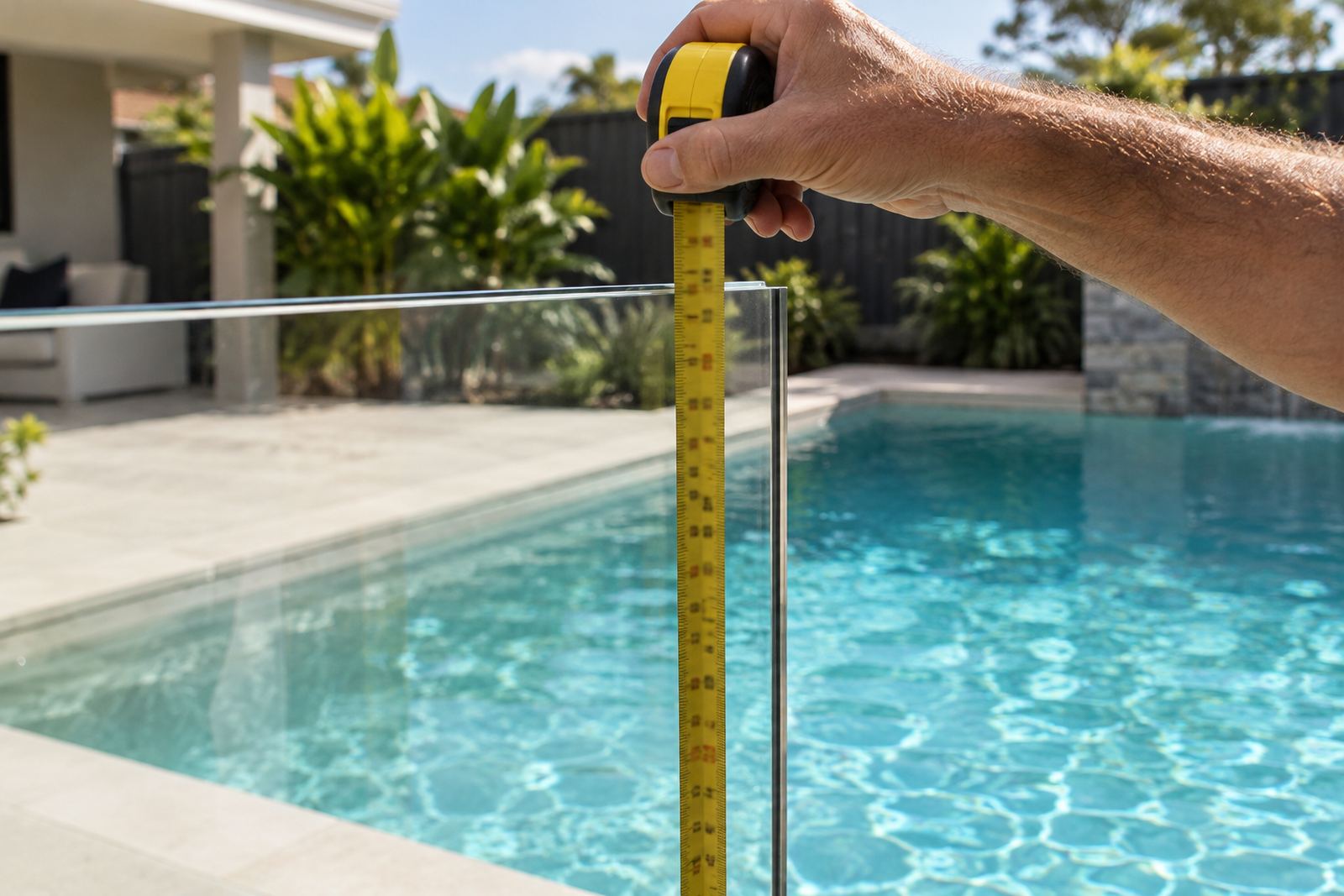
Take a tape measure and check these points along the whole fence line:
- Measure from the finished ground level up to the top of the barrier, on the outside. Check the lowest points as well as the highest.
- Look for mulch, garden beds, pavers or turf that have built up against the fence.
- Check the gap under the fence is 100mm or less.
- Check the spacing between palings, bars or glass panels is 100mm or less. The QBCC pool fence guidance explains how to measure the gap on horizontal rails.
- Look for damaged, loose, rusted or rotting sections.
If mulch has crept up, the simplest fix is to rake it back or lower the garden bed. Raising the fence is much more costly, so check this one first.
What is the non-climbable zone and how do you clear it?
The non-climbable zone is a continuous 900mm area around the pool barrier that a small child cannot climb. The QBCC non-climbable zone rules describe it as an area that must be kept clear so a child cannot use objects to scale the fence. It can sit on the inside or outside of the barrier, depending on the fence design.
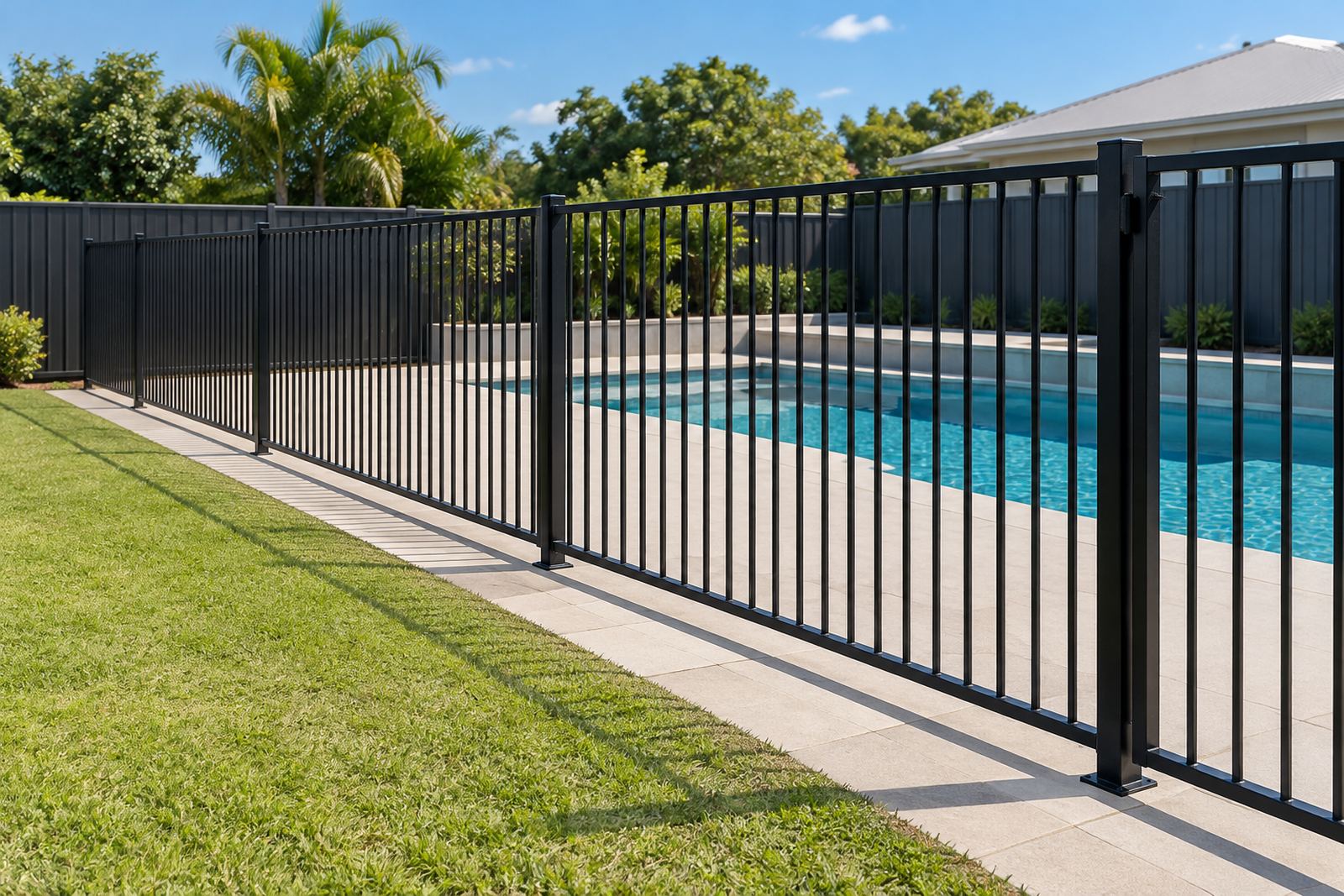
Walk the fence and look for anything within 900mm that works as a step:
- Pot plants, planter boxes and garden furniture.
- Pool pumps, filters and chlorinators placed against the fence.
- Bins, toys, ladders and pool equipment.
- Tree branches, shrubs and climbing plants. Overhanging branches from a neighbour’s tree count too, so talk to them early.
- Horizontal rails or footholds on the fence itself.
The summer trap is furniture. A lounge or esky moved against the fence for a party can turn a compliant barrier into a climbable one overnight. Make it a household rule that nothing lives within 900mm of the fence.
How should the pool gate work?
The gate must not open towards the pool, must be self-closing and must self-latch from any open position. These are the core gate requirements on the QBCC gate, latch and hinge rules page.
Test the gate rather than just looking at it:
| Test | What a pass looks like |
|---|---|
| Open it fully and let go | It swings shut and latches without a push |
| Hold it a few centimetres open and let go | It still closes and latches |
| Direction of swing | It opens away from the pool, never towards it |
| Latch release height | The underside of the release is at least 1500mm above the ground, or shielded as the standard allows |
| Hinges and latch | No sagging, rust, or stiff or loose parts |
| Propping | Nothing is holding the gate open |
The latch height figure comes from the Queensland Government owner and agent guideline. Hinges drop and latches wear, so tension springs and alignment are common failures. The QBCC notes that a heavily kicked ball or leaning on the gate can throw the gate out of alignment.
This matters because gates are where children get in. The 10-year national child drowning study found that in 36% of cases where a child drowned in a pool the child was able to access it because the gate had been left open. The study also found that of the pools with known fencing, 21% of fenced pools were not compliant with fencing legislation and 16% were faulty and not maintained.
Is your pool registered and do you need a certificate?
Every residential pool and outdoor spa in Queensland must be registered with the QBCC, and owners of unregistered pools may face fines. The Queensland Government pool registration page also covers some portable and indoor pools and spas, and says the register records pools, certificates issued and licensed inspectors.
A pool safety certificate is a separate thing. You need one when you sell or lease a property with a pool. The QBCC buying, selling or leasing page says certificates are valid for 2 years for non-shared pools, and a seller with a current certificate must give the buyer a copy before settlement. If there is no certificate when a property is sold, a Form 36 notice must be given to the buyer, and the new owner generally has 90 days after settlement to obtain the certificate, as set out in the Queensland Government guideline above.
Landlords should note that the Residential Tenancies Authority says a copy of the certificate should be included with the tenancy agreement.
If you plan to sell in the next year, book an inspection early. Failing it at the last minute can slow a sale, and our guide to Queensland pool fencing rules and pool safety certificates covers the process step by step.
What happens if your pool fails an inspection or a council check?
If an inspector finds the pool non-compliant they must issue a Form 26 non-conformity notice, and the owner then fixes the listed items. The QBCC explains this in its page on the role and responsibilities of a pool safety inspector, including a re-inspection window for pools fixed within a short time.
Councils can also check. The Brisbane City Council pool regulations say council inspects pools at random and issues on-the-spot fines for non-compliant fencing, ranging from one to 165 penalty units, with a penalty unit valued at $161.30 from 1 July 2024. Penalty unit values are indexed each year, so check the current figure. Do not treat the numbers as a prediction of what you would pay, since the outcome depends on the case.
The better reason to fix problems is safety. Royal Life Saving Society Australia reports that over the decade 2015 to 2025, 183 children aged 0 to 4 died by drowning in Australia, and 65% of those deaths were in swimming pools, mostly backyard pools where children got through a gate that was propped open or not properly closed.
A 15 point pre-summer checklist
Print this, walk the fence and tick each item.
- Barrier at least 1200mm high along its whole length.
- Garden beds, mulch and paving have not reduced the height.
- Gap under the barrier is 100mm or less.
- Gaps between bars, palings or panels are 100mm or less.
- Nothing climbable within 900mm of the fence.
- Trees and shrubs trimmed back, including neighbour overhang.
- Pool equipment is not acting as a step.
- Gate opens away from the pool.
- Gate self-closes from fully open.
- Gate self-latches from a slightly open position.
- Latch release at least 1500mm above ground or properly shielded.
- Hinges, springs and latch are not rusted, loose or sagging.
- CPR sign is displayed, readable and weatherproof.
- Pool or spa is registered with the QBCC.
- Pool safety certificate is current if you are selling or leasing.
Items 1 to 12 come from the barrier rules above. The CPR sign must be at least 300mm by 300mm and show CPR steps, according to the Queensland Government guideline linked earlier.
Planning a new pool? Build the safety in from day one
A new pool must have a compliant barrier before it can be filled, so fencing design and the pool layout should be planned together. Where the fence goes, how the gate swings and what sits near the fence all affect your yard for decades.
Ask every builder how the barrier will be handled, who certifies it and what is included in the price. Before you sign, check a pool builder’s QBCC licence and read how long a pool build takes so your schedule allows for inspections. A small plunge pool still needs a compliant barrier, so size does not remove the rules.
Supervision still matters most. A fence is a backstop, not a babysitter, and Royal Life Saving’s Keep Watch program stresses constant adult supervision of young children around water.
Ready to build or upgrade? Use our free quote tool to compare up to 3 QBCC-checked builders, or browse local builders on the Brisbane hub, with the other South East Queensland regions linked from there.
Frequently asked questions
How high must a pool fence be in Queensland?
At least 1200mm, measured from the ground on the outside. Garden beds and mulch that build up over time can reduce the height, so check it each year. Source: Queensland Government fences and barriers guidance.
What is the non-climbable zone?
A continuous 900mm zone around the pool barrier that a small child cannot climb. Keep pots, furniture, equipment and branches out of it.
Does my pool gate have to close by itself?
Yes. It must be self-closing, self-latching from any open position and must not open towards the pool. Never prop it open.
Do I have to register my pool?
Yes. All residential pools and outdoor spas in Queensland must be registered with the QBCC. Unregistered pools can attract fines.
When do I need a pool safety certificate?
When you sell or lease a property with a pool. For a non-shared pool a certificate is valid for 2 years. Only a licensed pool safety inspector can issue one.
Who checks that my pool fence is compliant?
Licensed pool safety inspectors issue certificates, and your local council can inspect and fine for non-compliant barriers.
Ready to compare builders?
Get up to 3 free quotes from licence-checked pool builders who work in your area.
Get free quotes