Plunge pools in South East Queensland: cost, size and approvals
A plunge pool in South East Queensland typically costs about $34,000 to $65,000 installed, based on published price lists, and measures around 2m x 3m to 4m x 2.5m. It needs the same building approval, 1200mm safety barrier and QBCC pool registration as a full size pool, but costs less to run and heat.
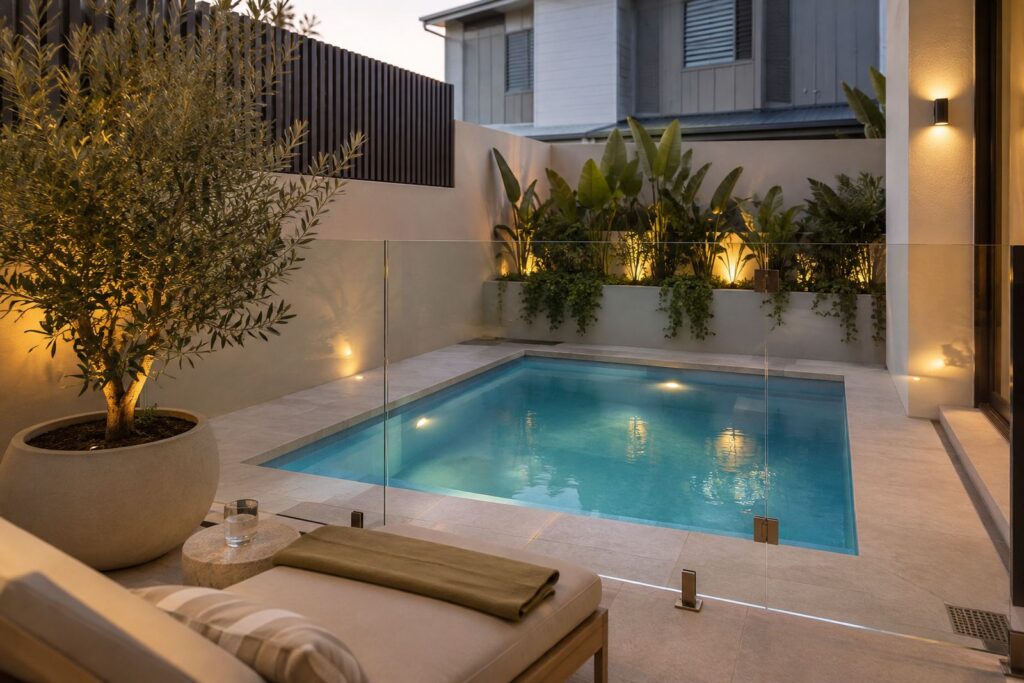
Key takeaways
- A plunge pool is a small pool, typically about 2m x 3m up to 4m x 2.5m and 1.2m to 1.5m deep, holding roughly 7,000 to 15,000 litres. There is no legal definition of the size.
- Published South East Queensland prices put installed plunge pools at roughly $34,000 to $65,000, depending on whether they are precast concrete, fibreglass or custom concrete (indicative estimates only).
- A plunge pool needs the same approvals as any pool: building approval, a compliant 1200mm safety barrier, and registration on the QBCC pool register.
- Small pools are cheaper to run and heat, and are often installed within days to a few weeks once approved.
- QBCC licensing, Home Warranty cover and deposit limits apply to plunge pools just as they do to larger pools.
A plunge pool in South East Queensland typically costs between about $34,000 and $65,000 installed, measures around 2m x 3m to 4m x 2.5m, and needs the same building approval, safety fence and pool registration as a full size pool. Plunge pools suit small yards, courtyards and townhouses, and are a popular choice for cooling off rather than swimming laps.
This guide explains plunge pool sizes, the main construction types, indicative costs from published South East Queensland price lists, approval and fencing rules, and running costs. All prices are estimates, not quotes.
What is a plunge pool?
A plunge pool is simply a small, usually fairly deep pool designed for cooling off, relaxing and light exercise rather than swimming laps. Many include built-in benches, steps and ledges, and some are fitted with jets so they can double as a spa when heated.
The term is not defined in Queensland law. Manufacturers and builders use it loosely: some call anything under about 4m long a plunge pool, while others sell “plunge pools” up to 6m or 7m. What matters legally is depth. Under Queensland law, any structure that can hold 300mm or more of water and is used for swimming, wading or similar counts as a swimming pool, as the QBCC explains on its swimming pool safety laws page.
What size is a plunge pool?
| Typical size | Approx. depth | Approx. volume | Suits |
|---|---|---|---|
| 2.5m round | 1.2m | About 5,900 litres | Courtyards, rooftop and small yards |
| 3m x 2m | 1.2m | About 7,200 litres | Small courtyards and townhouses |
| 4m x 2m to 4m x 2.5m | 1.4m to 1.5m | About 7,000 to 15,000 litres | Most suburban plunge pools |
| 4.5m x 3.5m or 4m x 4m | 1.5m to 1.8m | About 15,000 to 20,000 litres | Families wanting a bit more room |
| 5m to 5.5m long | 1.4m to 1.8m | About 11,000 to 25,000 litres | Borderline between plunge and small family pool |
Volumes are approximate and reduce with steps and benches. Compare that with a typical family pool of 40,000 to 60,000 litres, and you can see why plunge pools are cheaper to fill, heat and maintain.
How much does a plunge pool cost in South East Queensland?
Here are indicative installed prices drawn from plunge pool price lists published by South East Queensland builders and suppliers in 2025 and 2026.
| Plunge pool type | Indicative installed price (estimate) | Notes |
|---|---|---|
| Precast concrete plunge pool | About $34,000 to $65,000 | Factory-made concrete shell craned into place; one Gold Coast supplier publishes installed prices from about $34,000 to $44,700 |
| Fibreglass plunge pool | About $45,000 to $57,000 | One SEQ installer publishes seven models from 4m x 2m to 4m x 4m at roughly $45,700 to $57,300 installed, including excavation, crane, equipment and council fees |
| Custom concrete plunge pool | From about $45,000 to $63,000+ | Built on site; suits odd shapes and tight access |
| Plunge pool with spa jets and heating | Add several thousand dollars | A small pool heat pump starts from about $3,000 |
Fencing, paving, landscaping and difficult site works are often extra. A plunge pool in a tight courtyard may need a larger crane or hand excavation, and a sloping site can add retaining costs of $2,000 to more than $10,000. Rock is priced the same way as for larger pools, usually as a provisional sum.
Plunge pools are cheaper than family pools, but not dramatically so. Fixed costs such as approvals, equipment, crane hire, fencing and certification are similar whatever the size. For regional comparisons, see our guides to pool costs on the Gold Coast, in Brisbane and on the Sunshine Coast.
Precast, fibreglass or concrete: which plunge pool is best?
Precast concrete
Precast plunge pools are cast in a factory, then delivered and craned into position. They are heavy, durable and can be installed inground, partly inground or above ground, which suits sloping blocks and courtyards with no room for excavation. They need good crane access.
Fibreglass
Fibreglass plunge shells are lighter, have a smooth low-maintenance gelcoat and come in many shapes with built-in seating. They are usually installed within days of excavation. Like precast pools, they need crane access.
Custom concrete
A concrete plunge pool built on site can be any shape and depth, and can be designed around boundaries, rock or existing structures. It takes longer and usually costs more, but it is the most flexible option for awkward spaces.
Our guide to fibreglass vs concrete pools in Queensland compares the materials in more depth.
Do you need approval for a plunge pool in Queensland?
Yes. Small size does not reduce the requirements. The QBCC’s build a pool guidance says you must get building approval from your local council or a private certifier before building, and that your pool builder usually arranges it. Councils agree:
- The City of Gold Coast says all swimming pools and spas need a building approval and must be registered with the QBCC.
- Brisbane City Council says you need building approval for your pool and pool fence, and may need planning approval depending on zones and overlays.
- Sunshine Coast Council says you need building certification before construction starts, and temporary fencing during construction.
On small lots, boundary setbacks, easements and sewer lines are common constraints. Your certifier checks these, and can sometimes seek approval for a reduced setback through a referral agency response.
Does a plunge pool need a fence?
Yes. Any plunge pool capable of holding 300mm or more of water needs a barrier that complies with the Queensland pool safety standard: at least 1200mm high, with gaps of no more than 100mm, a 900mm non-climbable zone and a gate that opens away from the pool and self-closes and self-latches. Spas with lockable lids still need a compliant barrier.
On tight sites, the house wall, boundary fence or the raised wall of an above-ground plunge pool can sometimes form part of the barrier, but only if it meets every requirement of the standard. Read our guide to Queensland pool fencing rules and pool safety certificates for the details.
Your plunge pool must also be registered on the QBCC pool register, and you will need a pool safety certificate if you later sell or lease the property.
What licence does a plunge pool installer need?
Plunge pool work valued at more than $3,300 must be done by a QBCC licensed contractor. Fibreglass and precast installs fall under the swimming pool installation licence class, and concrete plunge pools under the construction class, according to the QBCC.
The same contract protections apply as for any pool: a written contract, a five business day cooling off period, a maximum deposit of 5% on contracts of $20,000 or more, and cover under the Queensland Home Warranty Scheme. Some suppliers sell precast or fibreglass shells “supply only”. If you buy the shell separately, make sure the company installing it is licensed and that the contract and warranty arrangements are clear. Our guide shows how to check a pool builder’s QBCC licence.
How long does it take to install a plunge pool?
Once approval is granted, precast and fibreglass plunge pools can often be excavated, lifted in and connected within a few days, with coping, paving and fencing taking another one to three weeks. Custom concrete plunge pools take longer because of steel, spraying and curing. Allow a few weeks before that for design and approval. Our guide on how long it takes to build a pool in Queensland covers each stage.
How much does a plunge pool cost to run?
Small pools use less water, fewer chemicals and smaller pumps, so running costs are lower than for a family pool. Heating is the big advantage: a small heat pump can keep a plunge pool warm enough for year-round use in South East Queensland at a far lower running cost than heating a large pool. Suppliers publish heat pumps for pools up to about 15,000 litres from around $3,000.
Some owners heat their plunge pool to spa temperatures in winter and keep it cool in summer, which effectively gives them a pool and a spa in one.
Remember noise limits if the equipment sits close to a neighbour. Under section 440T of the Environmental Protection Act 1994, pool pumps and heat pumps must not be audible at a neighbouring property before 7am or after 10pm, with stricter limits in the evening.
Is a plunge pool right for you?
A plunge pool suits you if you have a small yard or courtyard, you mainly want to cool off and relax, you want lower running costs, or you would like to heat the pool for year-round use.
Consider a larger pool if you want to swim laps, have several active children, or want room for pool games. A 6m to 7m family pool may cost only modestly more once fixed costs are counted.
Plunge pool, spa or swim spa: what is the difference?
These products overlap, which can be confusing. A plunge pool is a small pool, usually unheated or gently heated, used mainly for cooling off. A spa is smaller again, heated to warm temperatures and fitted with jets. A swim spa is a long, self-contained spa with a current generator so you can swim on the spot.
For Queensland pool safety laws, the label does not matter. If it can hold 300mm or more of water, it needs a compliant barrier and registration. The City of Gold Coast notes that even ice baths and spas with lockable lids are classed as swimming pools if they can hold more than 300mm of water.
Ways to make a small plunge pool feel bigger
- Use frameless glass fencing to keep sight lines open.
- Choose a light interior colour, which makes water look brighter and deeper.
- Add a wide bench or sun ledge so the pool works for sitting and lounging.
- Line the pool up with doors or windows so it becomes a view from inside.
- Add lighting so the pool is a feature after dark.
Where can you find plunge pool builders in South East Queensland?
Browse plunge pool builders in our directory, or search by region: Gold Coast, Brisbane, Sunshine Coast, Logan, Moreton Bay, Redland City and Noosa. Our how we rank page explains how listings are ordered.
Ready to price your plunge pool? Request free quotes from licence-checked builders who install plunge pools in your area.
Frequently asked questions
How much does a plunge pool cost in Queensland?
Published South East Queensland price lists put installed plunge pools at roughly $34,000 to $65,000, depending on whether they are precast concrete, fibreglass or custom concrete. Fencing, paving and difficult site works may be extra.
What size is a plunge pool?
Most plunge pools are about 2m x 3m to 4m x 2.5m and 1.2m to 1.5m deep, holding roughly 7,000 to 15,000 litres. There is no legal size definition, and some builders use the term for pools up to 5m or 6m long.
Do plunge pools need council approval in Queensland?
Yes. A plunge pool needs building approval through a building certifier, a compliant pool safety barrier and registration on the QBCC pool register, the same as a larger pool.
Does a plunge pool need a fence?
Yes. Any pool that can hold 300mm or more of water must have a barrier that complies with the Queensland pool safety standard, at least 1200mm high with a self-closing, self-latching gate.
Can you heat a plunge pool year round?
Yes. Because of its small volume, a plunge pool is much cheaper to heat than a family pool. Suppliers publish heat pumps for pools up to about 15,000 litres from around $3,000.
How long does it take to install a plunge pool?
Once approved, precast and fibreglass plunge pools can often be installed in a few days, with coping, paving and fencing taking one to three weeks more. Custom concrete plunge pools take longer.
Ready to compare builders?
Get up to 3 free quotes from licence-checked pool builders who work in your area.
Get free quotes