How long does it take to build a pool in Queensland?
Most Queensland pools take about 2 to 4 months from first quote to first swim. Once approvals are granted, builders typically install a fibreglass pool in 2 to 4 weeks of site work and build a concrete pool in 8 to 12 weeks or longer. Weather, rock, access and fence certification cause most delays.
Key takeaways
- From first quote to first swim, most Queensland pools take roughly 2 to 4 months. Concrete projects with complex sites can take 6 months or more.
- Once approvals are granted, a fibreglass pool is usually installed in 2 to 4 weeks of site work, and a concrete pool in 8 to 12 weeks or longer (builder estimates).
- Design, quoting and building approval commonly take 3 to 7 weeks before any digging starts, longer if planning approval, easements or engineering are involved.
- Wet weather, rock, groundwater, crane availability and fence certification are the most common causes of delay.
- Your contract must state a practical completion date or how it will be worked out, so check it before you sign.
Building a pool in Queensland typically takes 2 to 4 months from signing a contract to swimming in it. Fibreglass pools are the fastest, often finished within a few weeks of approval. Concrete pools usually need 8 to 12 weeks of construction after approval, and complex designs take longer.
The timeframes in this guide are estimates based on schedules published by South East Queensland pool builders and on the approval steps set by the QBCC and local councils. Every site is different, so ask your builder for a written schedule for your project.
How long does each stage of a pool build take?
| Stage | Fibreglass (estimate) | Concrete (estimate) |
|---|---|---|
| Design, site visit and quoting | 1 to 3 weeks | 1 to 4 weeks |
| Contract and cooling off period | 5 business days | 5 business days |
| Engineering, soil test and building approval | 2 to 4 weeks | 2 to 4 weeks, longer for complex sites |
| Shell manufacture or ordering | Often runs alongside approval | Not applicable |
| Excavation | 1 to 2 days | 1 to 5 days, longer with rock |
| Shell install or steel and plumbing | 1 to 3 days | About 1 week |
| Concrete spray and curing | Not applicable | Up to 4 weeks including curing |
| Coping, paving and interior finish | 1 to 2 weeks | 2 to 3 weeks |
| Permanent fence, final certification and fill | 1 to 2 weeks | 1 to 2 weeks |
| Typical total, first quote to first swim | About 6 to 12 weeks | About 12 to 20 weeks |
These stages overlap in practice. For example, a fibreglass shell is often ordered while the approval is being processed, and fencing contractors may be booked weeks in advance.
How long do pool approvals take in Queensland?
Before you build, you need a building approval. The QBCC’s build a pool guidance says you, or your builder, must obtain plans and engineering specifications and engage a private certifier or a council certifier. The certifier tells you if you need a structural report for a difficult site, or extra approvals, such as building over a sewer line or town planning approval in a special zone.
Many South East Queensland builders allow 2 to 4 weeks for certification on a straightforward site. Add time if:
- Your property is in an overlay that triggers planning approval. Brisbane City Council, for instance, says planning approval may be needed depending on zone, neighbourhood plan or overlays, which means lodging a development application.
- The pool is near a sewer, water or stormwater line. Building over or near infrastructure requires assessment and sometimes advice from the water utility, such as Urban Utilities in Brisbane, Ipswich, Logan, Lockyer Valley and Scenic Rim, or Unitywater on the Sunshine Coast and in Moreton Bay.
- You want to build within a boundary setback and need a referral agency response.
- A soil or geotechnical report is needed for clay, sand, rock or slope.
How long does a fibreglass pool take to install?
Fibreglass pools are the fastest option because the shell is made in a factory. A typical sequence once approval is granted:
- Excavation (1 to 2 days). The hole is dug slightly larger than the shell and a bed of crushed rock or sand is prepared.
- Delivery and crane lift (1 day). The shell is lifted in, levelled and positioned.
- Plumbing and backfill (1 to 3 days). Pipework is connected and the space around the shell is backfilled as the pool is partly filled with water to balance pressure.
- Bond beam and coping (around 1 week). A concrete collar is poured and coping installed.
- Equipment, paving and fencing (1 to 3 weeks). Filter, pump and sanitiser are connected, and paving and permanent fencing completed.
Builders commonly quote the shell installation within 1 to 2 weeks, with full handover including paving and fencing in about 4 to 6 weeks.
How long does a concrete pool take to build?
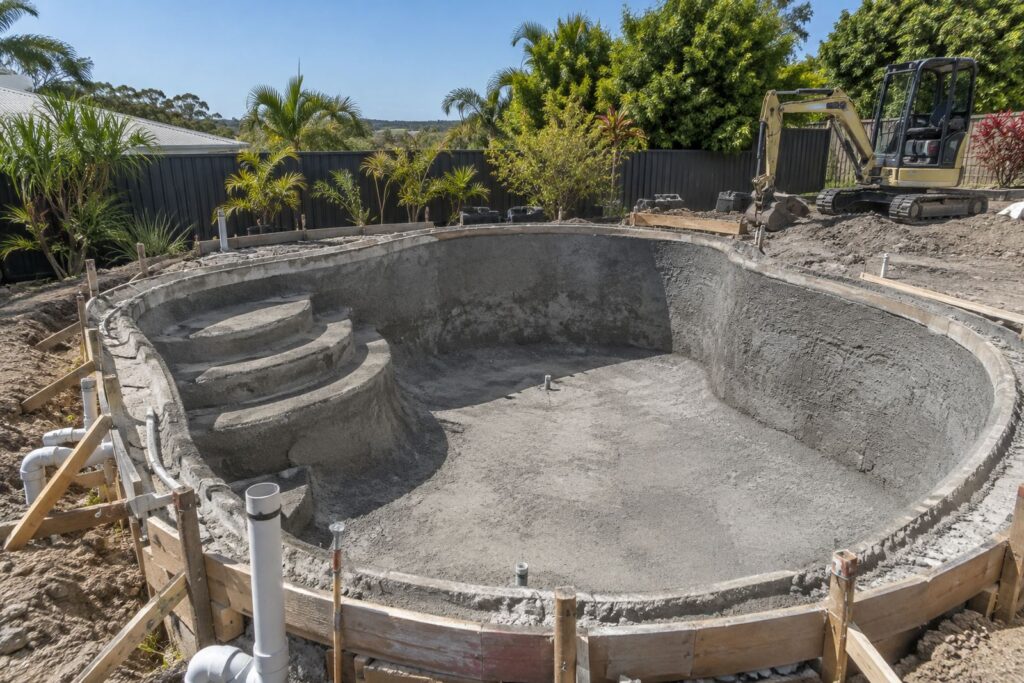
Concrete pools take longer because more happens on site and each stage must be finished before the next:
- Excavation (1 to 5 days). Longer where rock, groundwater or tight access is involved.
- Steel, plumbing and formwork (about 1 week). Reinforcement is placed and inspected, and pipework is laid.
- Concrete spray. Shotcrete or gunite is sprayed and shaped, usually in a day.
- Curing (up to 28 days). Concrete needs time to gain strength. Some builders continue other work during this period.
- Coping and tiling (1 to 2 weeks). Waterline tiles and coping are installed.
- Interior finish (a few days). Pebble, render or tile is applied, then the pool is filled.
- Paving, fencing and certification (1 to 3 weeks).
Brisbane builders commonly describe 8 to 12 weeks of construction for a concrete pool once approvals are in place, and 12 to 16 weeks or more from planning to first swim. Infinity edges, spas, suspended sections and retaining walls can push that to 5 or 6 months.
For a full comparison of the two pool types, read fibreglass vs concrete pools in Queensland.
What causes pool construction delays?
Weather
South East Queensland’s summer storm season is the biggest single cause of delay. Excavations fill with water, concrete pours are postponed and wet soil makes machinery access difficult. Concrete pools are more exposed because more work happens outdoors over a longer period.
Rock and groundwater
Hitting rock can add days of hammering or saw cutting. A high water table, common in coastal suburbs, can mean pumping before work can continue.
Access and crane booking
Fibreglass installs depend on crane availability. If your site needs a large crane or traffic management, booking lead times can add a week or more.
Peak season demand
Many people want a pool for summer, so builders are busiest from September to December. Signing in autumn or winter often means an earlier start.
Fence certification
A pool cannot be filled above 300mm until its fence is compliant. The QBCC explains that the certifier must inspect and certify the fence and issue a Form 17 (or Form 11) before filling. A temporary fence approved by the certifier (Form 16) can be relied on for up to 3 months. If the permanent fence is late, everything waits. Read Queensland pool fencing rules and pool safety certificates to understand the requirements.
Variations
Changing the design after signing, such as making the pool deeper or adding a spa, usually means updated plans and possibly a new approval.
What does your contract say about time?
The QBCC’s guide to domestic building contracts explains that contracts must state the date for practical completion, or how that date will be determined, for example within a set number of business days after work starts. Pool contracts should also include provisions for unforeseen events, such as rock during excavation or wet weather, as the QBCC’s build a pool page notes.
Ask your builder:
- What is the expected start date and practical completion date?
- How many wet weather days are allowed for, and how are extensions of time handled?
- What happens if the builder is late through no fault of yours?
- Who books and manages the fencing contractor and final inspection?
Payment timing also matters. The QBCC’s deposits and progress payments page says progress payments must relate to work completed, and builders cannot claim more than 50% of the price, including the deposit, until at least 50% of the work is done. If your project drags on and the builder fails to complete, the Queensland Home Warranty Scheme may cover non-completion, as long as the builder is licensed. Check that first with our guide to checking a pool builder’s QBCC licence.
When is the best time to start a pool in Queensland?
If you want to swim by Christmas, start talking to builders in autumn or early winter. That allows time for design and approval, and gets you into the construction queue before the spring rush. The drier months from about May to September are also kinder to excavation and concrete work in South East Queensland.
Starting later is fine, but expect longer waits for a start date and more weather risk during construction.
How can you speed up your pool build?
- Decide early. Finalise size, shape, interior and equipment before signing to avoid variations.
- Get a soil test early. It speeds up engineering and reduces surprises.
- Check overlays and easements upfront. Use your council’s online mapping to see whether planning approval is likely.
- Choose fibreglass if your site suits it. It is usually the fastest option.
- Book fencing and landscaping early. Coordinate trades so the permanent fence is ready when the pool is.
- Clear the access path. Remove obstacles and arrange neighbour access if needed before excavation day.
Do plunge pools take less time?
Usually, yes. Precast and fibreglass plunge pools can be installed in days once approved, and even small concrete plunge pools need less excavation and curing time. They still need the same approval, fencing and certification steps. See our plunge pools guide.
How does timing affect cost?
Longer builds tend to cost more, through extended equipment hire, temporary fencing and labour. Delays caused by rock or access are usually charged as variations. Our cost guides for the Gold Coast, Brisbane and the Sunshine Coast explain which factors move the price.
What happens after the pool is finished?
Handover is not quite the end. In the first weeks, expect to:
- Balance the water. New concrete interiors in particular push pH up for some months and need regular testing and adjustment.
- Learn the equipment. Ask your builder to show you how to run the pump, filter, sanitiser and any heating, and to set timers that respect neighbour noise limits.
- Check the registration. Confirm your pool appears on the QBCC pool register.
- Keep the paperwork. Store the building approval, Form 17 or Form 11, warranties and manuals. You will need them if you sell.
- Note defects early. Non-structural defects under the Home Warranty Scheme must be noticed within 6 months of substantial completion.
Where can you find pool builders with realistic timelines?
Browse pool builders in your area: Gold Coast, Brisbane, Sunshine Coast, Logan, Moreton Bay, Ipswich and Redland City. Learn how listings are ordered on our how we rank page.
Ready to start? Request free quotes and ask each builder for a written schedule with their expected start and completion dates.
Frequently asked questions
How long does a fibreglass pool take to install in Queensland?
Once approvals are granted, the shell is typically installed within 1 to 2 weeks, with full handover including paving and fencing in about 4 to 6 weeks. These are builder estimates and vary by site.
How long does a concrete pool take to build?
Builders commonly quote 8 to 12 weeks of construction after approval for a concrete pool, and 12 to 16 weeks or more from planning to first swim. Complex designs can take 5 to 6 months.
How long does pool approval take in Queensland?
Many builders allow 2 to 4 weeks for building certification on a straightforward site. Planning approval, building near sewer or stormwater lines, or reduced setbacks can add several weeks.
Why do concrete pools take longer?
Concrete pools are built on site in stages: excavation, steel and plumbing, spraying, curing of up to 28 days, coping, interior and fencing. Each stage must finish before the next, and wet weather affects more of the work.
What is the best time of year to build a pool in Queensland?
Starting design in autumn or early winter usually means an earlier start date and drier weather for excavation, with the pool ready before the summer rush.
Can I swim before the pool fence is certified?
No. The pool cannot be filled above 300mm until a compliant barrier is in place and certified, or a certifier-approved temporary fence is used for up to 3 months.
Ready to compare builders?
Get up to 3 free quotes from licence-checked pool builders who work in your area.
Get free quotes