Queensland pool fencing rules and pool safety certificates
In Queensland, any pool or spa that can hold 300mm or more of water needs a barrier at least 1200mm high with self-closing, self-latching gates, and must be registered with the QBCC. A pool safety certificate, valid for 2 years for non-shared pools, is required when selling or leasing a property.
Key takeaways
- In Queensland, any pool or spa that can hold 300mm or more of water must have a compliant barrier and be registered on the QBCC pool safety register.
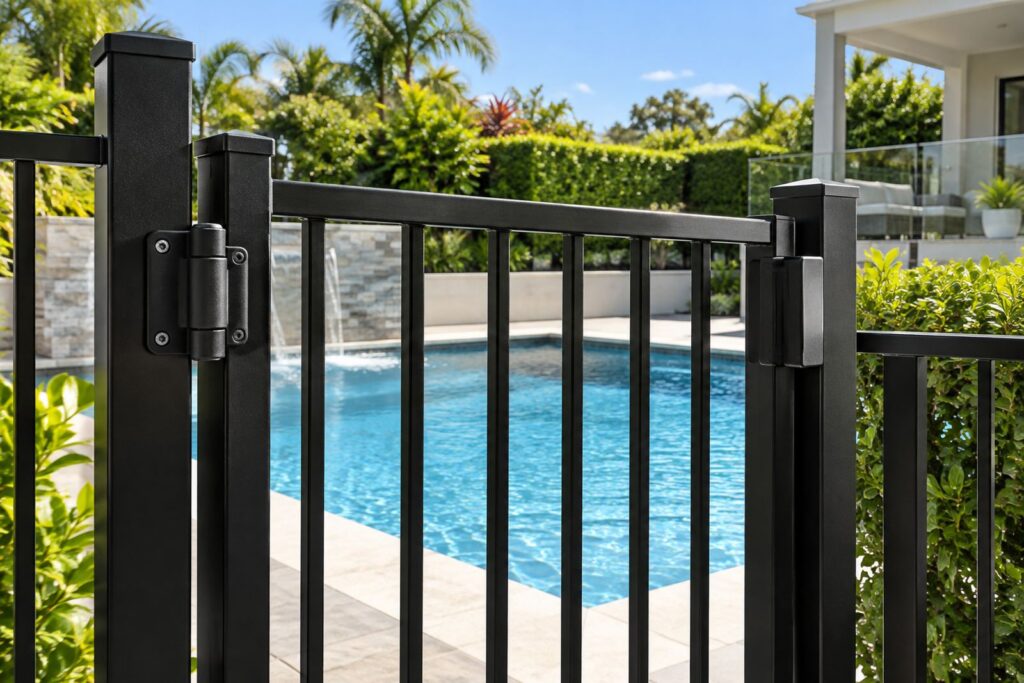
- Pool fences must be at least 1200mm high, with gaps no more than 100mm and a 900mm non-climbable zone. Gates must not open towards the pool and must self-close and self-latch from any position.
- A pool safety certificate is needed when you sell or lease a property with a pool. It is valid for 2 years for a non-shared pool and 1 year for a shared pool.
- If you sell without a certificate, you must give a Form 36, and the buyer must obtain a certificate within 90 days of settlement for a non-shared pool.
- New pools must have a certified permanent fence, or an approved temporary fence for up to 3 months, before being filled above 300mm.
Queensland pool safety laws require every regulated pool to have a compliant barrier at least 1200mm high with self-closing, self-latching gates, to be registered with the QBCC, and to have a current pool safety certificate whenever the property is sold or leased. The rules apply to new and existing pools, spas and even some portable pools.
This guide summarises the key rules from the QBCC and Queensland Government, explains how pool safety certificates work, and covers what happens when you build a new pool. It is general information, not legal advice. For your specific situation, speak with a licensed pool safety inspector or building certifier.
What counts as a swimming pool in Queensland?
According to the QBCC’s page on swimming pool safety laws, a swimming pool is any structure capable of being filled with water to a depth of 300mm or more and used primarily for swimming, wading, paddling or similar. That covers inground and above-ground pools, spas and hot tubs, and some inflatable or portable pools.
The City of Gold Coast notes that ice baths and spa pools capable of holding water deeper than 300mm are also classified as swimming pools, even if they have a lockable lid or cover. Portable wading pools are exempt only if they cannot be filled to 300mm, hold less than 2,000 litres and have no filtration system.
What are the Queensland pool fence rules?
All pool barriers must comply with Queensland Development Code MP 3.4, which calls up and modifies Australian Standard AS 1926.1, as explained on the Queensland Government’s pool fences page. The key measurements from the QBCC’s pool fences and gates, latches and hinges guidance are summarised below.
| Requirement | Rule (summary) |
|---|---|
| Fence height | At least 1200mm from finished ground level, at every point, including on slopes and steps |
| Gap under the fence | No more than 100mm from finished ground level |
| Gaps between vertical bars | No more than 100mm |
| Non-climbable zone | At least one gap of 900mm or more between horizontal rails, measured top of rail to top of rail |
| Clear zone outside the fence | No climbable objects or vegetation within 900mm |
| Clear zone inside the fence | No movable climbable objects within 300mm |
| Gate direction | Must not open towards the pool |
| Gate operation | Self-closing and self-latching from any open position |
| Outside latch height | At least 1500mm above finished ground level |
| Inside latch | At least 150mm below the top of the gate, with a 450mm radius shield |
| Windows opening into the pool area | Permanently restricted to open no more than 100mm, or fitted with fixed security screens |
If rails on the outside are less than 900mm apart, the QBCC describes two options: modify the fence so it cannot be climbed, for example with angled timber wedges and very close palings, or build it more than 1800mm high with the non-climbable zone on the inside.
The standard also requires a compliant cardiopulmonary resuscitation (CPR) sign to be displayed near the pool. Your pool safety inspector or certifier will check this.
Why do pool fences commonly fail inspection?
The Queensland Government lists the most common reasons barriers fail. In practice, inspectors often find:
- Gates that do not self-close and self-latch from every position, often due to dry or worn hinges.
- Garden beds, mulch or paving that has built up and reduced the fence height below 1200mm.
- Pot plants, pool pumps, chairs or trees within 900mm of the outside of the fence.
- Gaps under the fence that have grown beyond 100mm after soil erosion.
- Windows or doors that open directly into the pool area without compliant restrictions.
- Neighbouring structures, such as a retaining wall or shed, that create a foothold.
The QBCC’s tips include oiling gate hinges and latches, trimming vegetation within 900mm, and permanently fixing windows so they cannot open more than 100mm, noting that a window lock alone does not comply.
Do you need to register your pool?
Yes. The Queensland Government states that all residential pools and outdoor spas must be registered with the QBCC, and that owners of unregistered pools can face an on-the-spot fine or a higher penalty in court. You can check whether a pool is already registered at an address, and register it if not, through the QBCC’s search a register page. Registration is free.
For new pools, the building certifier provides the final certificate to the QBCC, but it is still worth checking that the registration appears.
What is a pool safety certificate?
A pool safety certificate (Form 23) confirms that your pool complied with the pool safety standard when it was inspected. According to the QBCC’s page on how to inspect and certify a pool:
- Certificates are valid for 2 years for non-shared pools and 1 year for shared pools, such as those in unit complexes.
- You need one when selling, buying or leasing a property with a pool.
- Only a QBCC licensed pool safety inspector can issue one.
- There is no set fee. The QBCC encourages owners to get a few quotes.
If the pool does not comply, the inspector issues a nonconformity notice (Form 26) listing what must be fixed. Inspectors can perform minor repairs connected with the inspection, but cannot do work valued at more than $3,300 without the appropriate licence and contract.
What happens when you sell a property with a pool?
The QBCC explains on its buy, sell or lease page that a seller with a current certificate must give a copy to the buyer before settlement. If the seller cannot obtain a certificate, they must lodge a Form 36, notice of no pool safety certificate.
The Queensland Government’s owner and agent guideline explains that the Form 36 must be given to prospective buyers before entering into a contract of sale, and to the QBCC before settlement. A Form 36 is not an exemption: the pool barrier must still comply. For a non-shared pool, the new owner must obtain a pool safety certificate within 90 days of settlement.
| Situation | What is required (summary) |
|---|---|
| Selling with a certificate | Give the buyer a copy before settlement |
| Selling without a certificate | Give a Form 36 to buyers before contract and the QBCC before settlement |
| Buying without a certificate (non-shared pool) | New owner must obtain a certificate within 90 days of settlement |
| Leasing a property with a non-shared pool | A current certificate is needed before the tenancy starts |
| Leasing in a complex with a shared pool | A copy of a current certificate must be given and displayed; if there is none, a Form 36 must be submitted |
What happens when you lease a property with a pool?
Landlords must have a current pool safety certificate before entering a lease for a property with a non-shared pool. The QBCC also states that where a certificate exists for a shared pool, a copy must be displayed as near as practicable to the entrance of the premises or pool access. Tenants must keep the pool gate closed and the pool area clear of climbable objects.
What are the rules for new pools under construction?
The QBCC’s build a pool page sets out the sequence:
- A pool under construction does not need to meet the pool safety standard until it is about to be filled to 300mm or more, but temporary fencing is commonly used for workplace safety during construction. Sunshine Coast Council, for example, says temporary fencing must be in place during construction.
- A temporary fence can be relied upon instead of a permanent fence for up to 3 months, if inspected and approved by the building certifier who approved the pool. The certifier issues a Form 16.
- Using a temporary fence for longer than 3 months needs further written approval from the certifier.
- Before the pool is filled above 300mm, the certifier must inspect and certify the fence and issue a Form 17 final inspection certificate, or a Form 11 certificate of occupancy where the pool is part of a new home.
New pool fencing of any height needs building approval. The City of Gold Coast notes this in its guide to which building works need approval. Your pool builder or certifier normally includes the fence in the pool approval.
Timing matters. Delays with the permanent fence are one of the most common reasons a finished pool cannot be filled. Read how long it takes to build a pool in Queensland to see where the fence fits in the schedule.
Can you get an exemption from pool fencing?
Limited exemptions exist, for example on grounds of disability access or impracticality, and are decided by your local council. The City of Gold Coast lists a pool fencing exemption application on its pool fencing page. Exemptions are not common, and you should not rely on getting one.
Who enforces pool safety rules?
The QBCC regulates pool safety inspectors and the pool register. Local councils handle complaints about non-compliant or unfenced pools and can issue compliance notices and fines. Logan City Council, for example, says it attends to pool safety concerns brought to its attention, works with owners to fix breaches and enforces compliance where needed. Propping a pool gate open is itself an offence under the Building Act 1975, according to the QBCC.
How do pool fencing and certificates affect your build budget?
Fencing is a significant line item in any new pool budget, typically several thousand dollars for aluminium and more for frameless glass. Some builders include the fence and certification in their price, others do not. Our cost guides for the Gold Coast, Brisbane and the Sunshine Coast show where fencing sits in a typical project. Even a small plunge pool needs a full compliant barrier.
Where can you find pool builders who handle fencing and certification?
Many builders in our directory manage the whole process, from approval to final fence certificate. Browse by region: Gold Coast, Brisbane, Sunshine Coast, Logan and Moreton Bay. Check any builder using our guide on how to check a QBCC licence, and see how we rank listings.
Planning a new pool? Request free quotes and ask each builder whether fencing and certification are included.
Frequently asked questions
How high does a pool fence need to be in Queensland?
At least 1200mm from finished ground level at every point along the fence, including on slopes and steps. The gap under the fence must be no more than 100mm.
How long is a pool safety certificate valid in Queensland?
A pool safety certificate is valid for 2 years for a non-shared pool and 1 year for a shared pool, such as one in a unit complex.
Do I need a pool safety certificate to sell my house?
You need either a current pool safety certificate, given to the buyer before settlement, or a Form 36 notice of no pool safety certificate. If a Form 36 is used for a non-shared pool, the buyer must get a certificate within 90 days of settlement.
Which way should a pool gate open?
A pool gate must not open towards the pool. It must also be self-closing and self-latching from any open position, with an outside latch at least 1500mm above the ground.
Does a spa with a lockable lid need a pool fence in Queensland?
Yes. Councils including the City of Gold Coast and Sunshine Coast Council say spas capable of holding more than 300mm of water must have a compliant barrier even if they have a lockable lid or cover.
Can I fill my new pool before the fence is finished?
Not above 300mm unless a compliant barrier is in place. A temporary fence approved by your building certifier can be used for up to 3 months. The certifier must certify the permanent fence before the final inspection certificate is issued.
Who can issue a pool safety certificate?
Only a pool safety inspector licensed by the QBCC. You can find one on the QBCC pool safety inspector register. There is no set fee, so get a few quotes.
Ready to compare builders?
Get up to 3 free quotes from licence-checked pool builders who work in your area.
Get free quotes